A strong foundation of local democracy in the U.P.

Joe Hubert is a research assistant at the University of Michigan’s Center for Local, State, and Urban Policy (CLOSUP), where he works on the Center’s “Close Up on the UP” project. He is a senior from Escanaba, and is studying Kinesiology, where he researches biomechanics as an assistant in the Athlete Innovation Laboratory.
“CLOSEUP on the UP” is a collaboration between CLOSUP, U-M’s UP Scholars Program, and Rural Insights.
In today’s political climate, understanding the political health of our local governments despite global challenges or federal political changes is important because it gives us insights into the impact that these things have on us and our immediate communities. The data presented in this article reflect Upper Peninsula local government officials’ perceptions of how well democracy functions in the United States and in their local communities between 2020 and 2025.


Since 2020, the Center for Local, State, and Urban Policy’s annual Michigan Public Policy Survey (MPPS) has asked local government leaders across the state for their overall assessments of democracy as a system of government at the local, state, and federal levels. Local officials are prompted on the survey to consider factors such as free and fair elections, rule of law, an unbiased free press, ethical and transparent governance, an informed and engaged electorate, among others. Then they are asked to evaluate the functioning of democracy on a 10-point scale with 1 as a total breakdown of democracy and 10 as perfectly functioning democracy. Scores of 1-4 on the scale signify low or poor assessments, and scores of 7-10 signify highly functioning democracy.
U.P. ratings for the functioning of democracy at the federal level:
From 2020 to 2022, the data indicate a relative decline in positive assessments among U.P. local leaders regarding federal democratic functioning. The proportion of local government leaders rating democracy as “high functioning” dropped from 17% in 2020 to 13% in 2022, while perceptions of “poor functioning” rose sharply from 41% to 61% during the same interval. This early trend suggests a period of declining confidence among local government officials, potentially reflecting heightened political polarization due to nationwide affairs such as disputes over the 2020 election process and ongoing challenges related to the COVID-19 pandemic and its aftermath.
Between 2022 and 2024, perceptions of federal democracy appear to stabilize at relatively low levels for Upper Peninsula local governments. The share of respondents identifying the functioning of federal democracy as “high functioning” remained near 14–16%, while “poor functioning” ratings hovered around 63–64%. This plateau may suggest skepticism about the effectiveness or responsiveness of federal institutions during this period.
However, the data from 2025 reveal a notable shift toward more favorable evaluations. “High functioning” assessments have risen to 24%, and “medium functioning” assessments increase to 25%, while perceptions of “poor functioning” decline significantly to 45%. This change marks the first substantial rebound in positive evaluations since 2020 and may indicate a partial restoration of trust in federal democratic institutions for U.P. local government officials. Factors contributing to this improvement could include perceived policy successes, greater institutional stability, or improved intergovernmental coordination. It also may reflect some partisanship leanings, since more survey respondents from the U.P. identify themselves as Republicans (39%), compared to Democrats (26%) or Independents (11%), or those who did not provide a party ID (23%). This might lead to more positive assessments this year of the federal government after the election of President Trump and the Republican-led Congress.
U.P. ratings for the functioning of the local democracy:
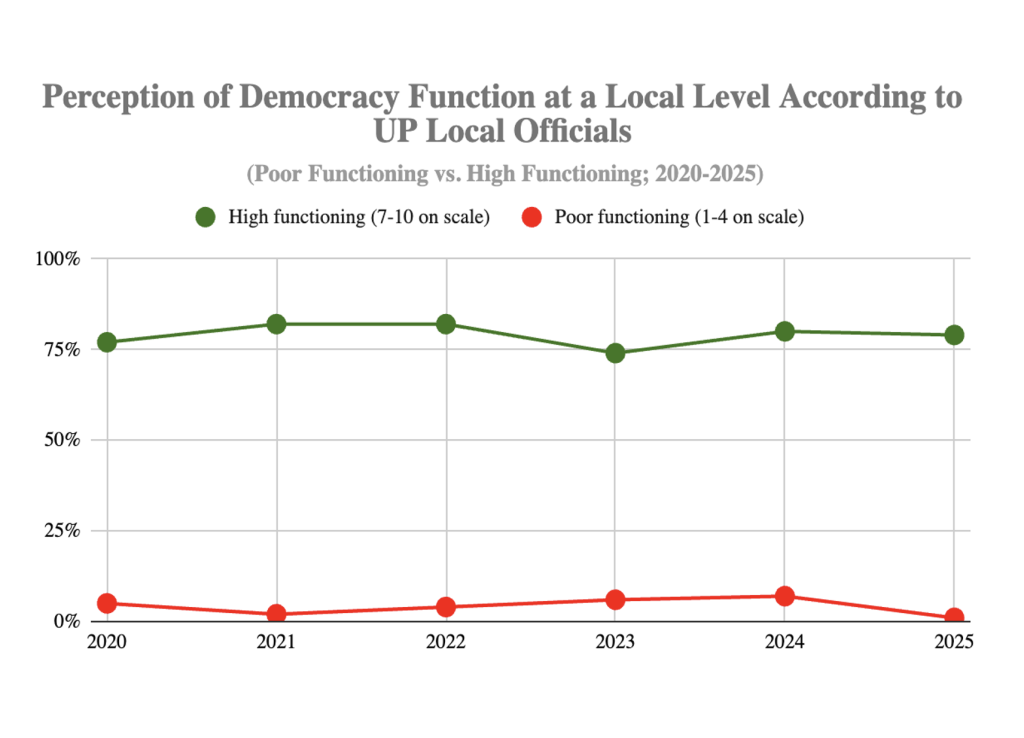
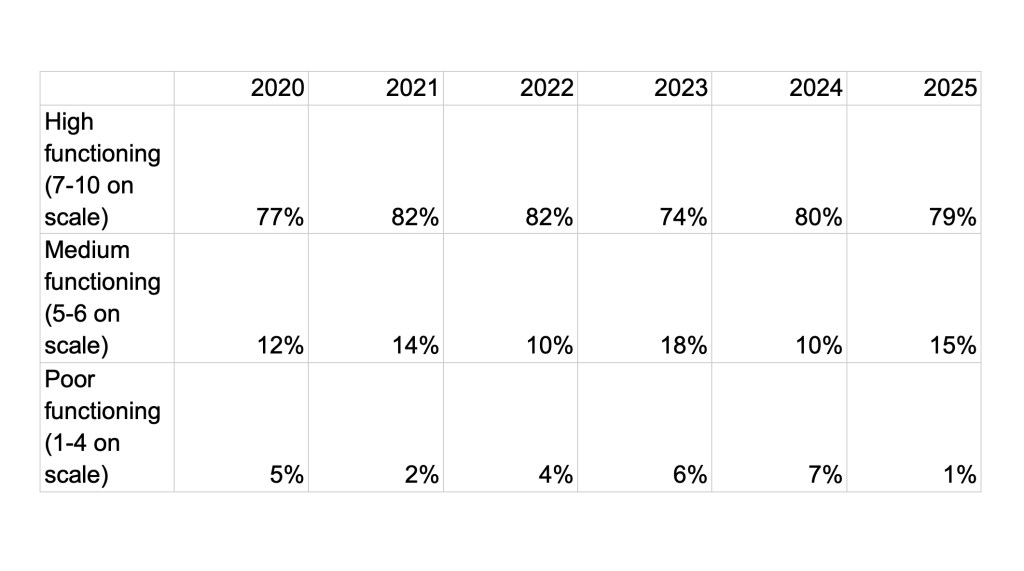
From 2020 to 2022, local officials consistently rated their own communities’ democratic functioning very positively. The proportion of respondents rating local democracy as “high functioning” was exceptionally strong at 77% in 2020 and increased slightly to 82% in both 2021 and 2022. “Poor functioning” ratings were minimal, ranging from 2–5%, indicating that only very few local officials perceived serious breakdowns in local democratic processes. This stability suggests strong confidence in the integrity, transparency, and responsiveness of U.P. government institutions, even as federal-level confidence was declining during the same period.
In 2023, there was a modest dip in “high functioning” assessments to 74%, with a slight increase in “medium functioning” and “poor functioning” ratings (18% and 6%, respectively). By 2024, confidence rebounded slightly, with 80% of officials rating local democracy as high functioning. The fluctuation likely reflects normal year-to-year variation rather than any systemic challenges, suggesting that U.P. governance, like many local governments, remains robust and relatively insulated from broader national political turbulence.
In 2025, positive evaluations remain strong, with 79% of officials rating their local democracy as high functioning and only 1% perceiving poor functioning. Medium functioning ratings are 15%, reflecting a small but noticeable portion of officials who see room for improvement. Overall, these results show a remarkably resilient perception of local democratic health, contrasting with the more volatile federal-level ratings.
CONCLUSION: Although there is, overall, a consistently high proportion of U.P. local government officials reporting poor democratic functioning at a national level over time, the trend in the data suggests a U-shaped trajectory; There is an initial period of decline, a plateau, and a subsequent recovery. This pattern describes the dynamic nature of political trust and democratic legitimacy as perceived from the local level, especially in a rural area, and highlights how broader political and social contexts can shape local officials’ confidence in national governance. But when it comes to local government, U.P. officials consistently report strong confidence in the functioning of local democracy. High-functioning ratings dominate each year, rarely dipping below 75% of respondents and perceptions of poor functioning remain minimal. This suggests that, despite national political turbulence and varying opinions about federal institutions, U.P. governments are consistently seen as effective, transparent, and responsive. The stability of these positive perceptions highlights that officials are more likely to trust the institutions they interact with daily, where accountability and engagement are tangible.
I believe that the data suggest a crucial lesson in that opinions of the federal government may waiver when partisanship changes or the political climate is unstable, but local U.P. governments will remain steadfast. U.P. local governments are overwhelmingly reported as high-functioning, indicating their responsiveness and effectiveness. Ultimately, I think this data underscores the value of strong local institutions in the U.P. which provide us with continuity, trust, and a foundation for a community that can sustain democracy even during national uncertainty.