Marquette Area Public Schools: A Case for Modernization
When asked what they remember most about their time in school, people often cite a favorite teacher, a class that launched their chosen career, or an extracurricular activity they enjoyed with friends. Almost no one ever mentions having to deal with drafty, cold classrooms; poor lighting; or broken lockers. Even fewer will reminisce about outdated furniture, unpredictable technology, or the lack of ADA accessibility in buildings. For many Michigan school districts, that’s the way things are – coping with broken or stained ceiling tiles, faulty water fountains, sound contamination between classrooms, and leaky roofs. Sadly, these and other serious deficiencies inhibit student learning, forcing local communities to search for answers!
According to the Government Accountability Office (GAO-20-94), 54% of public schools nationwide lack sufficient funds to update their building infrastructure. From school security to technology to HVAC and electrical systems, local districts struggle to modernize student learning facilities. In almost every case, the issue is insufficient funding for badly needed maintenance. Michigan is one of only twelve states that does not fund school infrastructure. This lack of support is what drives districts to seek millage increases to provide safe and functional classrooms.
The Marquette Area Public Schools (MAPS) understands this concern all too well. Between May of 2023 and December 2024, the State of Michigan conducted a facility assessment of the district’s seven instructional buildings. The State noted that resolving maintenance and structural issues through building replacements would cost $346.3 million. However, their study also showed that all buildings contained “solid bones” and could be repaired for $102.2 million. Coincidental with the State of Michigan assessment, the MAPS Board of Education’s own facility study for the same buildings showed a similar repair total of $112.6 million. Clearly, repair, not replacement, would be the better choice. The scenario is much like buying a new car. That bright, shiny set of wheels may be impressive, but proper maintenance on the family’s daily driver, while not glamorous, will adequately serve the need and is likely a better option. Fiscal responsibility makes the choice abundantly clear.
Why It Matters:
Public education is generally considered a right at the state level in our country, with every state constitution mandating a public school system. Michigan law promises that all children are entitled to free and appropriate public education, but the reality of providing that education is a complex and costly operation that goes far beyond the four walls of a classroom. Fulfilling this promise means ensuring that every student has reliable, safe transportation to school, access to high-quality food services that fuel their learning, and robust special education programs tailored to address diverse, individual needs. However, while the state mandates these essential services, it provides no dedicated funding for the physical infrastructure—the buses, the kitchens, and the specialized sensory or therapy spaces—required to deliver them. As a result, the responsibility of maintaining the facilities that make these entitlements a reality falls entirely on the local community. MAPS facilities house important instructional programming, arts, and athletics experiences districtwide. Addressing priority building needs now will help to control long‑term costs, improve safety and accessibility, and modernize learning spaces for current and future students.
MAPS Proposal
To provide a safe, functional learning environment, MAPS spent 2025 reviewing all of its building repair needs and identified “Priority 1 projects” totaling $60 million. To gauge the public’s interest in funding these essential repairs, the Board conducted a community survey that received nearly 2,000 responses (376 were needed to ensure statistical significance). The survey results showed that 69% of respondents favored supporting a $60 million bond (1.55 mills) to complete a variety of critical infrastructure projects. With unanimous Board approval, that bond vote is scheduled for May 5, 2026. If passed and added to the district’s existing sinking fund, MAPS will have a combined millage rate of 2.86 (significantly below that of other large U.P. school districts).
This bond proposal funds a host of critical projects, touching every school:
- 40% – Bothwell Middle School. Second‑floor renovation; addition remodeling; Career, Technical Education (CTE) spaces; athletic lockers; music rooms; Americans with Disabilities Act (ADA) improvements; public address system upgrades; windows/facade; LED lighting; technology.
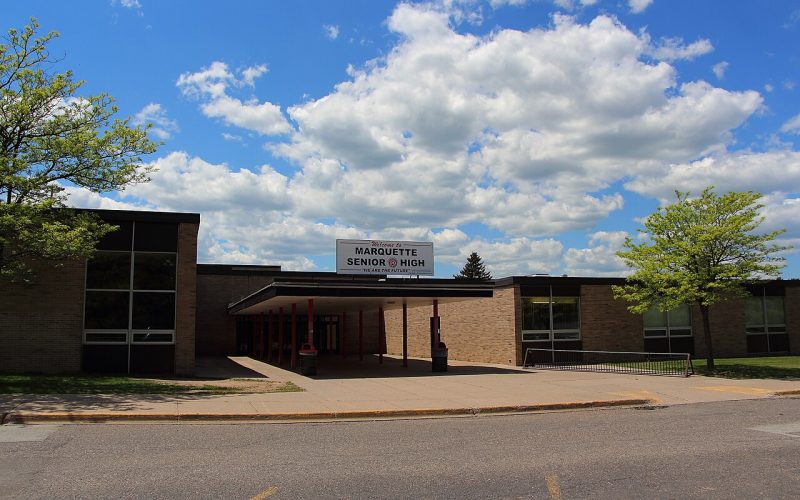
- 29% – Marquette Senior High School. CTE spaces; athletic lockers; music rooms; ADA; LED lighting; technology; press box renovation; cafeteria & media center; natatorium upgrades; classroom furniture.
- 11% – Graveraet Elementary School. ADA; electrical; technology; classroom furniture & renovations; heating/ventilation; playground; Kaufman Auditorium updates.
- 8% – Sandy Knoll Elementary School. ADA; electrical; technology; classroom furniture & renovations; heating/ventilation; playground; art room improvements
- 6% – Marquette Alternative High School. ADA; electrical; technology; classroom furniture; heating/ventilation; meeting room creation; science classroom.
- 3% – Cherry Creek Elementary School. LED lighting, technology, classroom furniture, playground, and exterior doors.
- 2% – Superior Hills Elementary School. LED lighting, technology, classroom furniture, and exterior doors.
MAPS understands that a $60 million list of improvement projects does not fix everything. It does, however, make significant progress in addressing maintenance and programming needs that have, for too long, been left unfunded. It also arrests building decay, which only leads to higher costs if deferred. Importantly, every school in the district (the newest of which is over 30 years old) benefits from the proposal, with investments tailored to each building’s highest‑priority needs as identified through facility studies and community surveys.
These improvements are designed not only to meet current instructional and safety standards but also to reduce long‑term operational costs and improve facility reliability across the district.
To Conclude:
There are myriad components to delivering pre-K-12 education, but it universally begins with instruction centered on Maslow’s hierarchy of needs.1 In the education arena, this means providing a safe, functional infrastructure to give each student the opportunity to achieve their full potential through programming (curriculum). Fundamentally, students must not be distracted by their physical environment if we expect them to excel in their studies!
Nelson Mandela opined that “education is the most powerful weapon which you can use to change the world.” In economics, we refer to people as “human capital.” School bonds can provide the infrastructure that helps generate this capital. Marquette needs strong schools to attract businesses and continue sustained growth. Our colleges and universities can only be successful if students arrive on campus properly prepared. Construction trades require a skilled, educated workforce capable of mastering complex new technologies. MAPS believes that making this type of investment to build and renovate career and technical education spaces, update critical infrastructure, and create modern classrooms and programs will help afford all students the opportunity to reach their potential. This is not abstract—renewing Marquette Public Schools provides the specific tools and environment needed to equip our students with the communication, social, and technical skills required for the U.P.’s future workforce. It’s an investment that benefits everyone.
For detailed information regarding size and scope associated with the Marquette Area Public Schools bond proposal vote scheduled for May 5, 2026, please visit: https://www.mapsnet.org/page/2026-bond-information or call (906) 225-4200.
1The five levels of Maslow’s Hierarchy of Needs, from bottom to top, are Physiological (food, water, sleep), Safety (security, health, stability), Love & Belonging (friendship, family, intimacy), Esteem (respect, confidence, status), and Self-Actualization (achieving full potential, creativity). These needs form a pyramid, with basic survival needs at the bottom that must be met before higher-level needs can be pursued.