
President Trump, Canada, the Upper Peninsula and Tourists

In January 2026, President Trump posted on Truth Social a doctored image of the U.S. flag flying over Canada and Greenland. This image marks the latest of numerous efforts in the President’s year-long campaign for Canada to become the 51st state against the expressed wishes of most Canadians and their government.
In the first months of 2025, the U.S. imposed a 35 percent tariff on Canadian goods not covered by existing trade agreements and a 50 percent tariff on steel, aluminum, and copper imports. In the second half of the year the President abruptly cancelled trade negotiations with Canada and threatened to hit the country with even more tariffs. Canadians have responded to these and other provocations by boycotting American goods and travel to the U.S.
With Canada accounting for over a quarter of foreign U.S. visitors, the United States has long been Canada’s primary international travel destination due to its proximity and warmer climate. According to the U.S. Travel Association, in 2024 Canadian visitors spent $20.5 billion which supported 140,000 American jobs.
However, economic uncertainty brought about by tariffs and threats by the President to annex their country has forced Canadians to rethink their relationship to the United States. The Canadian government is negotiating new trade agreements with other countries while at the individual level, fewer Canadian citizens are electing to travel to the U.S. A Pew Research Center Poll in spring 2025 found that 64% of Canadians held a negative view of the US – the highest ever recorded in over 20 years of polling by Pew.
Canadians made 22.9 million visits to the U.S. by car or plane in 2025, compared with 31.9 million the previous year according to preliminary Statistics Canada data. Angus Reid, a Canadian polling company, reported in November 2025 that 70 percent of Canadians surveyed “would be uncomfortable travelling to the United States this winter, and two-thirds (65%) describe new border requirements for long-term visitors – including fingerprinting and registration fees – as invasive.”
The effect of fewer Canadians on business activity is particularly noticeable in border states. Tourism marketing agency Explore Minnesota found in a 2025 state survey that 70 percent of tourism businesses reported a somewhat or significant decrease in Canadian business relative to 2024. In Upstate New York, the North Country Chamber of Commerce reported that 83 percent of businesses experienced a decrease in Canadian customers during the summer, with 35 percent reducing staffing levels to meet the decline.
On the West Coast, ridership between Vancouver Island and Seattle on the Seattle-based ferry service Clipper Navigation dropped by 30 percent during the summer and the company laid off a quarter of its workforce. Canada is not the only country seeing fewer citizens travel to the U.S. Indeed, the number of international visitors to the US dropped 6% in 2025 compared to 2024, with countries in Western Europe and Asia experiencing the largest drop in tourist numbers. Visitors from Denmark, for example, have declined in response to President Trump’s threats to annex Greenland, an autonomous Danish territory.
So why is travel to the U.S. important to the U.P. and Michigan? In one word, the answer is jobs. According to the U.S. Department of Commerce’s International Trade Administration, every 40 international visitors support 1 US job.
Last year Rural Insights published two articles detailing the decline in the number of travelers crossing the International Bridge at Sault Ste Marie into Michigan, the remainder of this article updates the latest cross border statistics and reports on the impact fewer Canadians is having on Michigan’s local economy, looking at Sault Ste Marie as a case study.
Cross Border Travel
The number of people crossing from Canada into the United States by land in 2025 was down by 10.7 million or 20% compared with 2024, according to US Customs and Border Protection statistics. At the Sault Ste Marie crossing, there were about 270,000 fewer travelers from Canada crossing the International Bridge, compared to 2024. That is a 25 percent drop (Table 1). The biggest drop-off in travel occurred during the peak summer months between June and September.
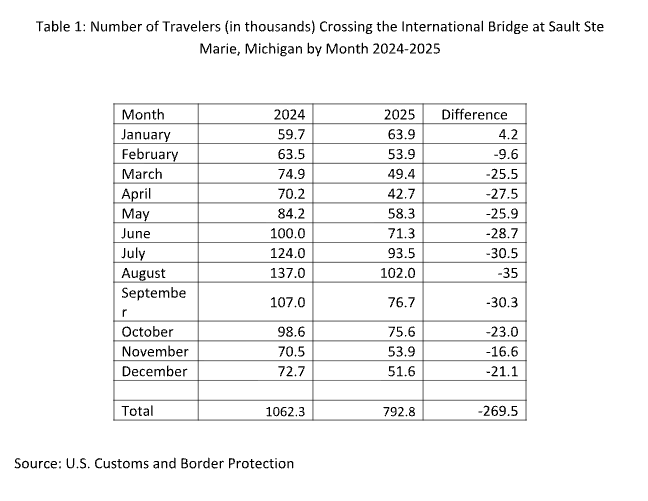
According to Statistics Canada’s Frontier Counts, day trips account for about 37 percent of cross border travel between Ontario and the United States, with the remainder involving an overnight stay. This suggests that for Sault Ste Marie, Michigan, the actual drop off in Canadian visitors amounts to approximately 99,900 (37% of 270,000).
Fewer Canadians on the US side of the border have been noticed by area residents. In a January 2026 article published on the Canadian Broadcasting Corporation’s website, a regular visitor to the US side observed, “It seems to be a little quieter. You used to see a lot of cars with Ontario license plates in the parking lots …. and it doesn’t seem like it’s as many.” A local Michigan businessman noted, “I think we could be doing a lot better than we are right now if we had better relations with Canada and Canadian customers.”
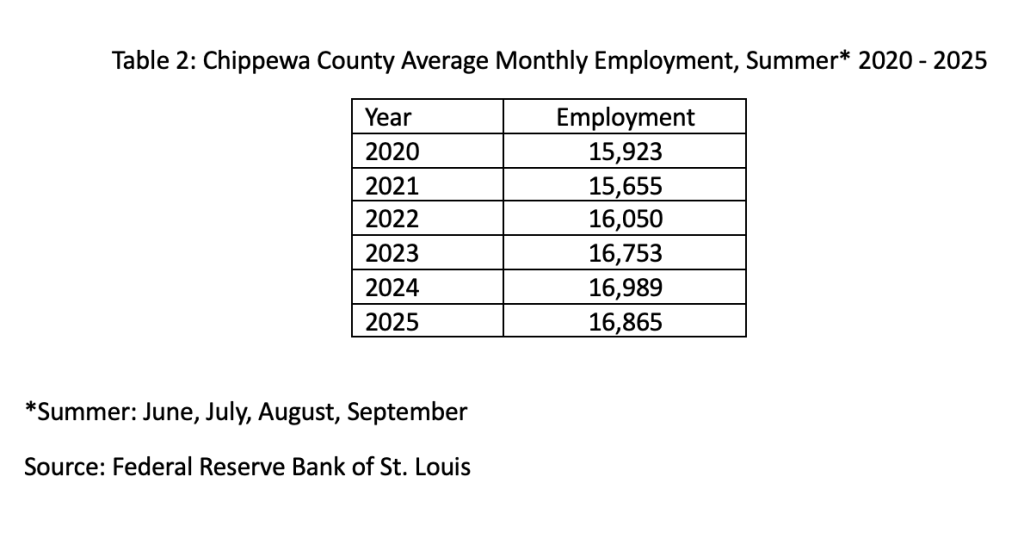
Other Sault Michigan business people say the decline in Canadian visitors began 25 years ago with tighter border restrictions after 9/11 and got worse during the COVID-19 pandemic. These observations are supported, in part, by average summer employment data for Chippewa County, which indicate a recovery from the effects of the COVID pandemic between 2021 and 2024 and then a small decline in 2025 (Table 2). Average summer unemployment edged up from 5.8 percent in 2024 to 6.4 percent in 2025, suggesting that the effects of fewer Canadian visitors have negatively impacted some area businesses.
Conclusions
Fewer people are electing to visit the U.S. in response to the President’s rhetoric and policies. Ironically, President Trump’s tariff policies are designed to remedy trade imbalances, but as more Americans travel abroad than international tourists visit the U.S. the country has a travel trade deficit. Historically the U.S. has enjoyed a travel trade surplus. But for 2025, the U.S. Travel Association, forecasts a deficit of nearly $70 billion. Most consumer boycotts typically peter out after some time. In this instance, avoiding travel to the U.S. may persist for a while as Canadians travel to other countries or explore their own. In Sault Ste Marie, Michigan fewer Canadian visitors are linked to a small increase in area unemployment and a decline in total employment, but whether this is a temporary phenomenon remains to be determined.




This is no surprise unfortunately.
What are the Canadian travel statistics to other places? Are there increases to other countries? Are the Canadians choosing for stay-cations (plenty of excellent places for that). You have only half a story here.
Canadian leaders have been steadily moving too close to China and away from the US.
The 51st state issue is not a moot point. There presently is a huge citizen driven petition drive for a 2026 vote for the province of Alberta to leave Canada. They’ll be either a autonomous country or a US territory.
Under the Joslin Brown article “they” who?
Regarding Alberta, there are occasionally petitions or movements that call for separation or other political changes. However, these tend to represent a relatively small, vocal group rather than the views of most Albertans. Polling and past election results generally show that the vast majority of people in Alberta support remaining part of Canada.
I’ve said before that Trump is a dog…but he’s our dog. He likes us and generally does what we want him to do. He barks too much, goes on peoples lawns and leaves some messes to clean up. In the long run it will be a good relationship.
Trump likes nobody but himself. And does things only to benefit himself.
Your conclusion lacks evidence. “Most consumer boycotts typically peter out after some time. In this instance, avoiding travel to the U.S. may persist for a while as Canadians travel to other countries or explore their own.”
Also, Miss Brown consider a professional photo if you want to be taken seriously. Sitting on a couch cross legged with blue hair makes you look child like.
Ro, I offer this comment not out of hostility, but just as an effort to help improve the quality of discussion here. Perhaps you don’t realize it, but your comment about the author’s hair makes you sound bigoted and small-minded. If you want to be taken seriously, you should focus on the content of the article, not the author’s appearance.
This is a good, informative article, and the authors deserve thanks for their effort to address an important issue for the UP and the state overall. And thanks to Rural Insights, as well, for publishing this.
I live near the Soo, and the Canadians are very hurt by what Trump did to them, especially since they sent their soldiers to shed their blood for the US after 9-11. I do not blame them, they have been our “best friends” and did not deserve the treatment our country has given. Business in the Soo is down a lot, we also used to count on Canada to supply us with nurses at the hospital. According to my Canadian friends, they would have to be crazy to want to be part of the US, why would they give up their health care? We will pay for Trumps shenanigans for a very long time.
Upper Peninsula voted Red once again, which is against their interests, largely because of the propaganda of Fox News blasted 24/7. I was once proud of a great Gogebic County educational system, but not anymore. People need to seek truth.
There is a decent chance that there was election tampering in 2024 by Elon Musk, but a lot of Americans voted for a felon that clearly said he was going to impose drastic tarrifs and make border crossings a challenging proposition. Most of those voters evidently weren’t listening. I won’t visit Canada, as maybe (because I’m ant-Trump and had a couple of misdemeanors decades ago) I won’t get back in and instead will wind up in jail, maybe even in El Salvador.
Maybe this is bitter medicine.