
Viewing Nature: An Analysis of Exposure to Nature in the Upper Peninsula
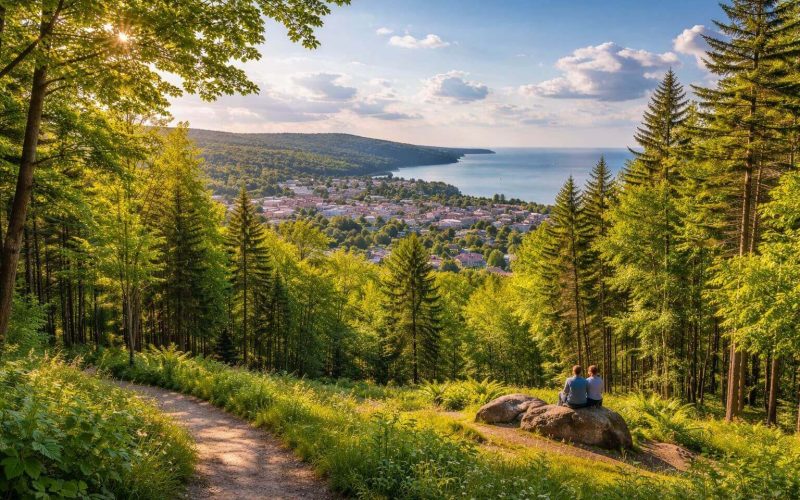
Living in the Upper Peninsula and being surrounded by natural beauty, it is easy to take for granted nature’s innate beneficial effects on not only our bodily health but also our psyches. These effects can be classified as Ecosystem Services – a fancy term for the different ways humans (and non-humans) prosper from healthy environments.
Trees, for example, provide regulating and supporting services by helping filter rain water, reducing runoff, storing and sequestering carbon dioxide from the air through photosynthesis and providing shade during the summer. Less well known are the positive health outcomes tied to exposure to nature including lower blood pressure, reduced healing times, reduced stress, reduced risk of poor mental health and improved cognitive ability.
Over the course of a day, people are exposed to a variety of natural and unnatural environments that vary according to a person’s lifestyle. Natural landscapes can be experienced indirectly such as having a view of nature from home or work or while carrying out another activity (e.g. walking a dog or walking to school). It can also be experienced more intentionally by visiting a park or garden. Since most people spend much of their day inside, the most common nature experience is the view from home or work.
Having a room with a view of nature does not mean that people are experiencing that view continuously; instead, most of their time will be spent on other tasks, while a window with a natural scene allows micro-restorative experiences. During the COVID-19 pandemic when people were spending significantly more time indoors, those who had views of trees and greenspace from their home reported lower rates of depression and anxiety.
Trees are a highly visible component of nature’s presence in the landscape, and as such their location is critical for determining how often and how long people experience them. This article analyzes the distribution of trees in the Upper Peninsula’s major urban areas to determine variations in the degree of exposure to their beneficial effects, but first, an overview is provided of research linking exposure to trees with positive health outcomes.
Trees and Human Health
Individuals score worse on the General Health Questionnaire (a screening instrument used to identify mental health problems) when living in less green urban areas in England, while higher rates of depression and anxiety disorder have been found in less green areas of the Netherlands. Exposure to green spaces such as parks and gardens promote stress reduction by encouraging physical activity and/or socialization, while tree-lined streets can also aid in reducing stress. People who have either visual or physical access to elements of nature benefit from physiological and psychological “restoration” promoted by natural elements.
A Toronto based study found that people who live in areas that have more (and/or larger) trees on the streets report better self-health perception, after controlling for demographic factors such as income, age and education. In the United Kingdom, areas of London with a higher density of street trees were found to have lower antidepressant prescription rates, this relationship remained after controlling for a number of other variables (e.g. socio-economic status).
A similar study in the German city of Leipzig found fewer antidepressant prescriptions were associated with a higher density of trees within 100 meters (approximately 110 yards) of a person’s home. According to the study’s authors, low socio-economic status is related to a higher prevalence of depression, but the likelihood of a person of low socio-economic status being prescribed antidepressants was significantly lowered if there was a high density of trees within 100 meters of their home. In sum, there is a significant body of research identifying positive health benefits arising from exposure to trees, whether it be intentional, e.g. a visit to a park, or inadvertent by looking at greenspace out of a window.
Variations in Exposure to Trees in U.P.’s Major Cities
Tree cover data are from the American Forests’ Tree Equity website (https://www.treeequityscore.org/). For each city and their census blocks (the smallest geographic unit used by the Census Bureau for tabulation of 100-percent data) the percentage tree cover is calculated using satellite imagery. Houghton has the highest amount of tree cover at 52 percent; Escanaba’s 19 percent figure is the lowest; while half of the cities fall within the 30-39 percent range (Table 1).
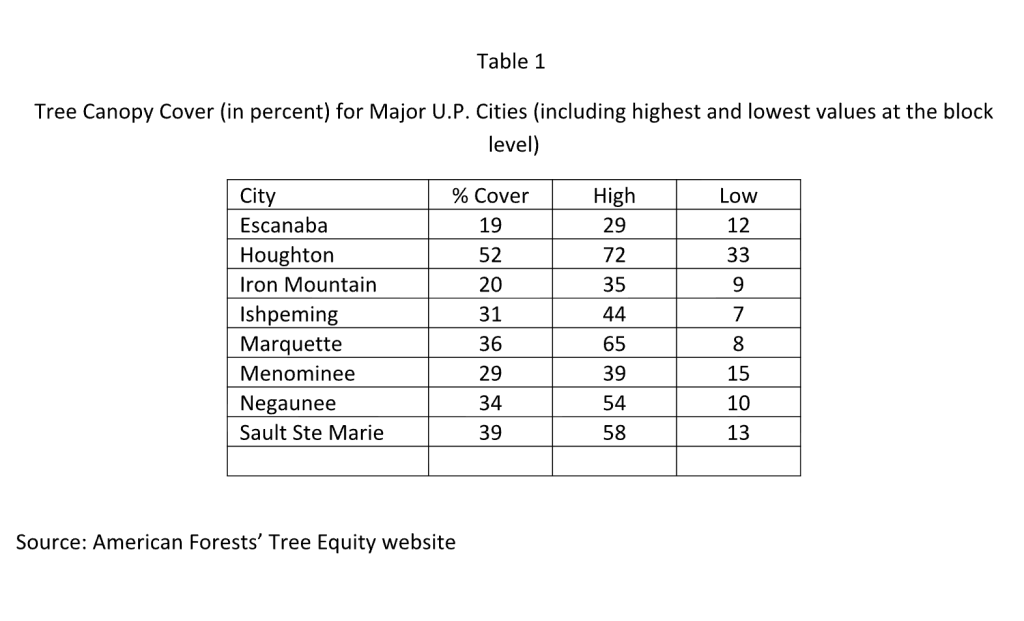
Within each city there are wide variations in tree cover. In general, the lowest amounts of tree cover are associated with downtown areas, where commercial activities dominate. In contrast, higher values are typically found further away from the downtown. Downtown Ishpeming has a tree cover figure of 7 percent, while the equivalent figure for a neighborhood on the city’s southside is 44 percent. Marquette’s downtown area tree cover figure is 8 percent, and the city’s highest figure (65%) is associated with an area on the city’s south side composed of newer homes. In Sault Ste Marie the downtown and area alongside the Soo Canal have tree cover values of 13 and 17 percent, while a residential neighborhood alongside the St. Marys River has the city’s highest value at 58 percent.
A Case Study of Marquette County
A deeper dive into the census block data enables the identification of residential areas which would benefit the most from increased tree planting. On the north side of the city of Marquette, a census block containing 838 people has a tree canopy cover of 8 percent, and not surprisingly it has the highest health burden index in the city. The index is a measure of general health developed by the Centers for Disease Control, and is based on self-reported prevalence of poor mental health, poor physical health, asthma and heart disease. A similar pattern is evident in Negaunee and Ishpeming, residents of neighborhoods with low tree cover (13 percent or less), have the highest health burden index.
Conclusions
Given the current federal policy of Making America Healthy Again, planting more trees in urban areas is a simple, cost-effective means of providing long term environmental and health benefits. The Tree Equity website provides tools for policymakers to identify those residential areas that would benefit the most from planting more trees. But it’s important to acknowledge that this strategy is no quick fix for the nuanced health challenges experienced by urban dwellers; similarly, it will take time for the tangible environmental benefits to accrue from lush healthy landscapes. The question for policy makers is whether they are prepared to invest in the future, knowing that the benefits will be deferred.
Note:
For readers who wish to learn more about the health benefits of exposure to nature, Good Nature: why seeing, smelling, hearing, and touching plants is good for our health (Simon and Schuster 2024) by Kathy Willis, Professor of Biodiversity at Oxford University, is an excellent resource.





Nice article. Thanks
When I travel I try wherever possible to stay in cities listed as Tree Cities – generally more tranquil, safe and fun to visit – https://en.wikipedia.org/wiki/List_of_Tree_Cities_USA
Cool that this body of research is growing! I’ve been reading about this for years. Nice to see it being validated over time.