
Zero Migration: Implications for the U.P.
At the end of January 2026, the White House issued the following press release, “Due to President Trump’s immigration crackdown, the U.S. had negative net migration in 2025 – the first time in at least a half-century.”
The statement continued, “The Trump administration has deported more than 605,000 illegal aliens, with an additional 1.9 million self-deporting, bringing the total number of illegals who have left the U.S. since President Trump returned to office to over 2.5 million.”
Despite the administration’s claim of 1.9 million people “self-deporting,” it did not support its assertion with data; one potential source is the Customs & Border Protection Home app which undocumented immigrants use to obtain a free flight and a (current) $2,600 payment, if they leave the U.S.
Alongside deportation, the country’s rate of natural increase – the excess of births over deaths – remains low. In Michigan, the number of births has fallen below its number of deaths every year since 2020. This situation is unlikely to change due to an aging population. In 2000, the state’s median age was 35.5, with 12 percent of the population over the age of 65; by 2024, the median age was 40.4 with 19.6 percent of the population over the age of 65.
With more deaths than births, the state’s population can only grow through internal migration and/or immigration. According to a Brookings 2026 analysis of census data, between 2024 and 2025 the state’s population increased by 27,922, with immigration accounting for all of this growth. Michigan is not alone in this phenomenon. Immigration was responsible for all of a state’s population growth in more than a dozen states including Pennsylvania, Illinois, Oregon, Louisiana and Alaska.
The purpose of this article is to examine how recent changes in U.S. immigration policy are playing out in the Upper Peninsula in relation to the region’s aging population. Prior to the analysis a brief overview is provided of current national policies towards immigrants.
Immigration Policy
Immigration was a top issue in the 2024 Presidential campaign, with candidate Trump promising to execute “the largest domestic deportation operation” in U.S. history while securing the border with Mexico against unauthorized migrants. Since becoming President, he has made the country more hostile to legal and unauthorized immigrants.
To accomplish the administration’s mass deportation goal, it has militarized immigration enforcement. This is seen in the increased funding for and deployment of ICE (Immigration and Customs Enforcement). Scenes of troops and masked federal agents roaming U.S. streets and violently subduing (and even killing) individuals have occurred in some of the country’s largest cities such as Minneapolis and Chicago.
The hardline approach has stripped temporary legal protections from more than 1.5 million humanitarian parolees, completely halted refugee resettlement (except for a cap of 7,500 for white South Africans) and severely restricted access to asylum. It has slowed the granting of lawful permanent residence, temporary visas, and U.S. citizenship, while new fees (e.g. $100,000 for a H1-B visa, and $250 for a visa integrity fee on top of the standard visa application fee of $185) have created further obstacles for would-be immigrants and regular visitors.
In January 2026, the administration announced that it would indefinitely freeze visa processing for people coming from seventy-five countries including Afghanistan, Brazil, Egypt, and Russia. The combined effect of these various measures has been a severe reduction in U.S. immigration, and immigrants’ contribution to the country’s population growth.
Immigrants and the Upper Peninsula
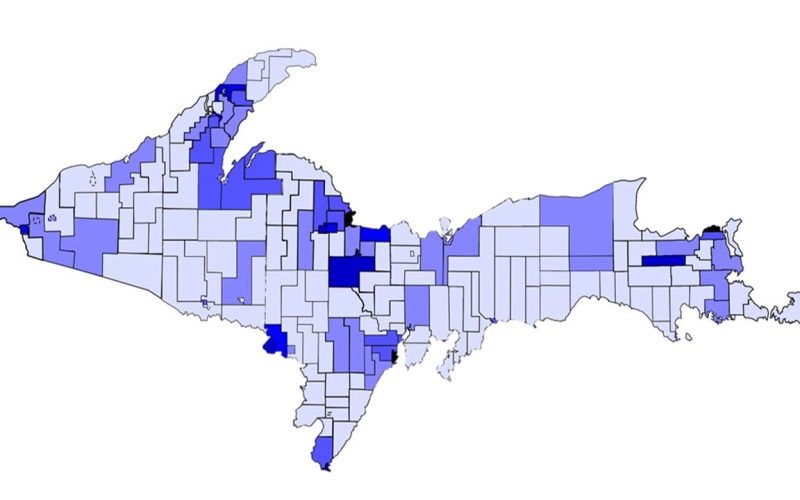
Back in 1910, the percent of foreign-born residents in Michigan stood at 21 percent, today that figure is 7.2 percent, which is well below the national figure of 15.4 percent (Table 1). At the turn of the twentieth century immigrants flocked to work in the U.P.’s booming mining economy.
Today, the region attracts few immigrants. In 2020-24, less than 2 percent of the population in 11 U.P. counties are foreign born, the highest percentages can be found in Houghton (5.3%) and Mackinac (5.9%) counties. These data should be treated with a degree of caution due to the small sample size used by the Census Bureau in compiling the statistics. Nevertheless, compared with national and statewide figures, immigrants play a minimal role in contributing to the region’s overall population growth.
Current and Future Population Growth in the U.P.
A number of previously published Rural Insights articles have outlined the U.P.’s population dynamics. Like most rural areas in the U.S., the region’s decline in the number of births combined with an increase in the number of deaths due to an aging population means that many counties have a natural decrease in population, i.e. there are more deaths than births (Table 2).
Beginning in the mid-1990s the number of deaths has exceeded the number of births. Preliminary birth data for 2025 indicate 2,357 total births for the region, well below the 3,961 recorded in 1990. Researchers attribute fewer births to later marriage, less marriage, an enhanced desire for a career-oriented lifestyle and delayed parenthood.
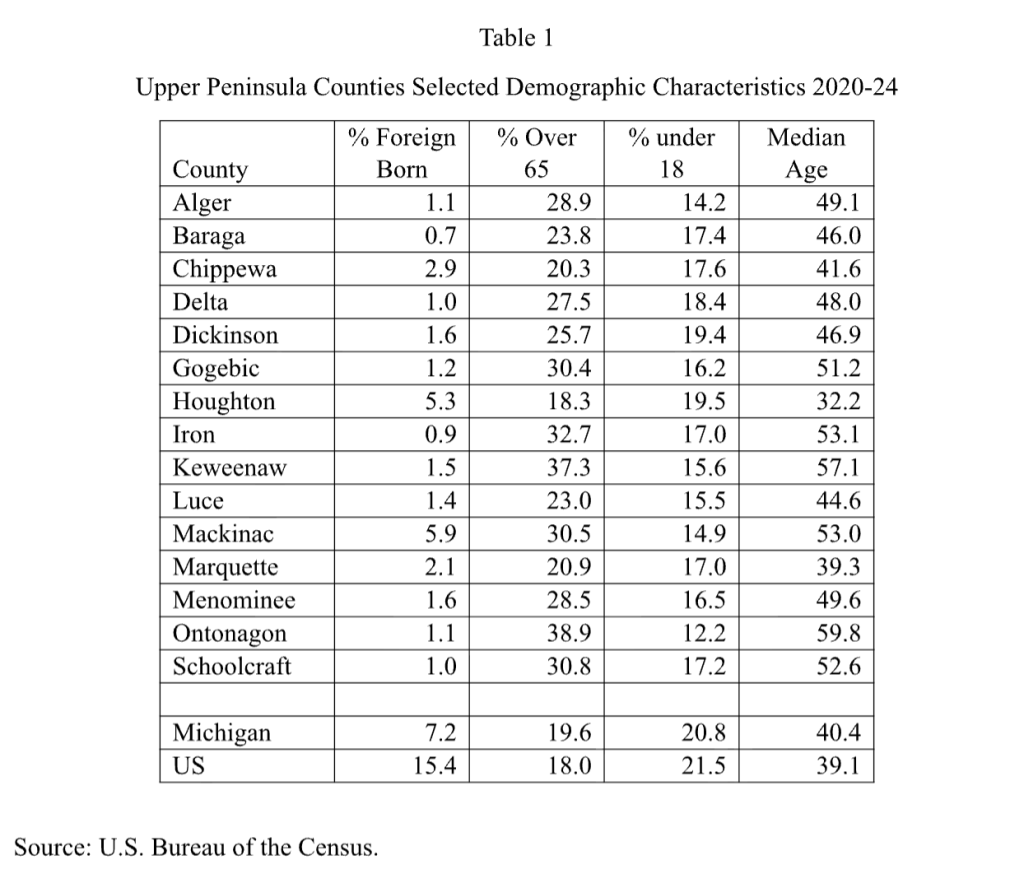
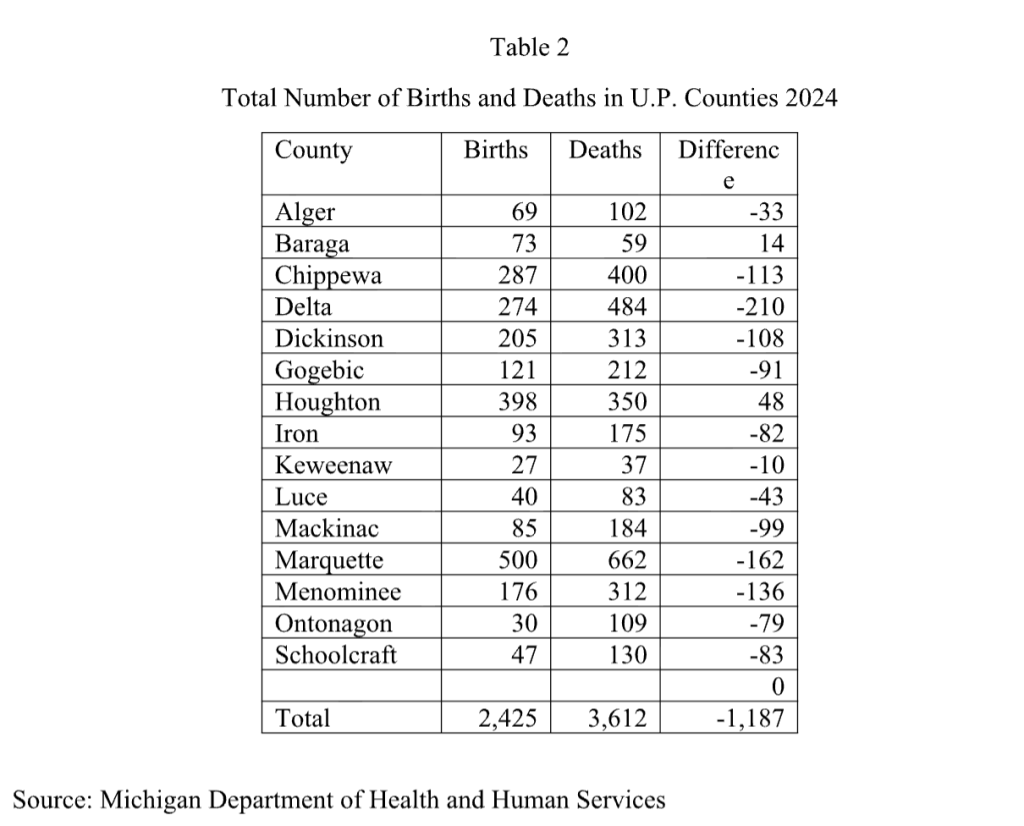
Looking ahead, it’s hard to see a return to a situation where the number of births exceeds deaths. Houghton County is the only county where there are more people under the age of 18 than over 65 (Table 1), it’s also the only county which has experienced a steady rise in the number of births over the past 10 years. This is due, in part, to its comparatively youthful population (median age 32.2) and higher percentage of immigrants.
In contrast, most other counties have median ages in the 40s and 50s, and more people over the age of 65 than under 18. The next “youngest” population (median age 39.3) is in Marquette County, which has experienced an almost continuous decline in its number of births from over 1,000 back in 1990 to half that number in 2024.
Economic Implications
The economic implications of a shrinking labor force is a cause of concern for policymakers across the globe. The U.S. fell below the so-called replacement level in the mid-1970s, leaving immigration to be the primary source of population growth.
Unless there is an alteration in the current administration’s immigration policies population decline is the most likely outcome. A smaller population and a slower-growing workforce will constrain America’s economy. Plenty of industries rely upon immigrant workers e.g. construction, accommodation and food service. As migrants stop arriving or are deported, companies will struggle to recruit, since unemployment is already low.
Without new arrivals, the country’s working-age population will fall, and there will be few people paying taxes, at the same time that the demands of an aging population are increasing (e.g. Medicare, Social Security). Given the reluctance by politicians to address these long-term challenges, rising public debt and service cuts seem an inevitability.
In addition to the humanitarian and economic issues attached to the current administration’s immigration policy, many U.P. counties will have to deal with the challenges posed by a declining population.


9 Comments
Leave a Comment
Newsletter
Related Articles

Basically trump and his immigration policies have not helped the ruralized UP. Getting rid of hard working immigrants with no criminal records as these are a majority like 90% of the deportees. President Obama and Biden got rid of the criminalized immigrants not the hard working ones. Also Trump and his failed immigration policies incarcerated many here at a cost of $700-$1000 per day and some housing was even more. His cronies have been enriched by his policies….We need a population that replaces itself and that is not happening across the USA. A time for a change the rural population needs to support the no king’s movement to increase our population and it is starting across the USA.
Houghton County’s having the highest percentage of foreign-born residents of all the UP counties is due to the presence of Michigan Tech, which attracts many foreign students to its STEM programs. No doubt NNM accounts for the bump in foreign-born residents in Marquette county. As for the UP as a whole, it is noteworthy that the region went, in less than 100 years, from being full of foreign-born and young residents, to a land [except as noted, with the counties having four year colleges] full of native-born and elderly residents.
Other countries have discovered the downside of an aging and fading population such as Japan. Eventually there is insufficient younger people to care for the aging population. I believe Japan has had to resort to planned immigration.
“the state’s population can only grow through internal migration and/or immigration” that this is the only way to grow population? You can’t think of any other way? No need to read past that
Obviously there is natural reproduction. You have to have a financially secure younger generation and an economy with good paying jobs to pay for the costs of child rearing, healthcare, education, both at the family level and the institutional level. Declining tax bases due to declining economies doesnt result in vibrant infrastructure investments. So far no country has been able to promote fertility as a solution, and the reason mainly is the cost of maintaining a family. If a country like Sweden, where they have a pretty robust social safety net system cannot do it, do you really think the USA can?
Extremely interesting article – quite gloomy and should be a warning to employers.
Yes 100 years ago the UP was teeming with Finnish,Swedish, and Norwegian immigrants fascinated with a land between two of the water planets most, undisputibly. Sacred fresh water seas. All the hip young scholastic pilgrims at NMU,all the similar gifted technical visionaries at NMT/Houghton…don’t even dent this vast downward spiraling population quandary the UP faces. Meanwhile just across the border where a more judicious governmental architecture fosters a parliamentary political process that covers every single Canadian citizen in their own country thoroughly illuminates just how bogus OUR nations so called political infrastructure really is. NOT TO MENTION DEAR friends how reverential aware the average Canadians are that the immigrant population keeps their entire provinces industries from settling into operational sludge like what’s happening in Michigan!!,
Thank you for this article. Well done.
interesting that no mention of taxes or that all the states mentioned are run by democrats … no issue in florida or texas or tennessee… want to pay more.. vote democrat … in florida and other states they have no state income taxes … this and other reasons bring people to their states…also being tax friendly to industry is a key .. no corporate groups are going to come to michigan with the burden the state puts on them .. the u p needs industry jobs.. jobs also bring people … don’t blame trump .. all are welcome by applying for proper citizenship… blame local government in lansing … they are a joke