Going to war, it happened before
War is a violent, often unavoidable conflict that has shaped American experience since the Korean War began in 1950. During that period, the United States has been forced or has chosen to conduct overseas military operations for the last 75 years. Warfare is marked by brutality and human suffering for participants. Its motivations are complex. It often represents a catastrophic failure of leadership and diplomacy. Here is an example of how things happen, sometimes for all the wrong reasons.
The Tonkin Gulf Crisis of August 1964
President Lyndon B. Johnson and his Secretary of Defense, Robert S. McNamara, grew concerned in early 1964, just after Johnson took office, which was also an election year, that the Republic of Vietnam (South Vietnam), America’s ally, was losing its fight against Communist-sponsored Viet Cong guerrillas. As it turned out, a minor clash between the naval forces of the United States and the Democratic Republic of Vietnam (North Vietnam) in August 1964 would mark a pivotal moment in the Cold War struggle for Southeast Asia. American leaders had been seeking a way to put military pressure on Ho Chi Minh’s North Vietnamese government in Hanoi, which had been directing and providing military support for the Communists in the South. Johnson, McNamara, and their so-called ‘best and brightest’ advisors, who had been carried over from the Kennedy Administration, believed that additional direct-action pin-prick naval activity in the north, combined with other measures, could somehow compel the land-based Viet Cong to conclude ground operations far away in the South. Sort of a ‘don’t just stand there, do something’ decision-making approach.
The U.S. armed the Republic of Vietnam Navy with small Norwegian-built fast patrol boats (PTF), trained Vietnamese crews, and maintained the vessels at Da Nang in northern South Vietnam. Known as Covert Operation 34A Desoto Patrol, this classified operation was designed and directed by officials in Washington and Saigon and was not publicly disclosed. The PTFs shelled radar stations along the North Vietnamese coast with their small guns and landed South Vietnamese commandos to destroy bridges and other military targets. However, many missions had little effect or failed due to poor intelligence, opposition, or weather. These operations were also known as MAROPS. Consequently, to compensate for limited impact and increase pressure, the U.S. Navy was directed to intensify its focus on the North Vietnamese coast during the Desoto Patrol operations by deploying American destroyers, backed by two aircraft carrier groups operating much farther south around Yankee Station. The stated purpose was to conduct intelligence-gathering missions just outside the internationally recognized territorial waters along the northern coast. Consequently, in early August 1964, the destroyer USS Maddox (DD 731), an obsolete, unaltered WWII-vintage destroyer, began patrolling near the North Vietnamese coast, gathering intelligence; essentially, she was conducting what we now call Freedom of Navigation operations and showing the flag. Coincidentally, the secret South Vietnamese PTF force had shelled targets further south of Maddox’s patrol area. To Hanoi, the Maddox appeared to be directly supporting these attacks and provoking the North Vietnamese; the two operations were underway simultaneously.
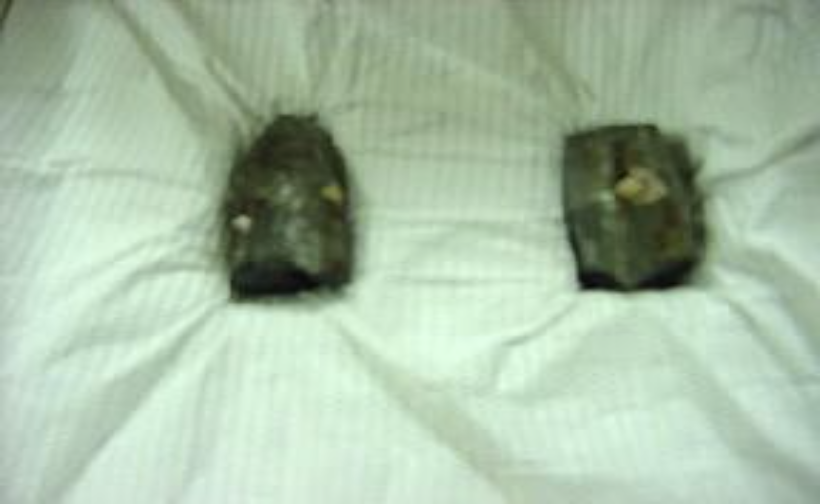
These two tiny thumb-sized fragments of the North Vietnamese machine gun bullets recovered from USS Maddox following the 2 August 1964 attack in the Gulf of Tonkin lit the fuse that started a war. (From the collection of the Curator Branch, Naval History and Heritage Command)
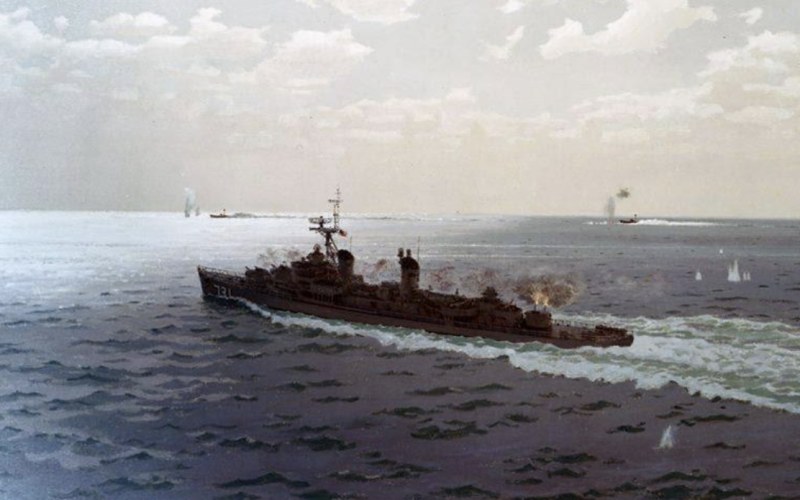
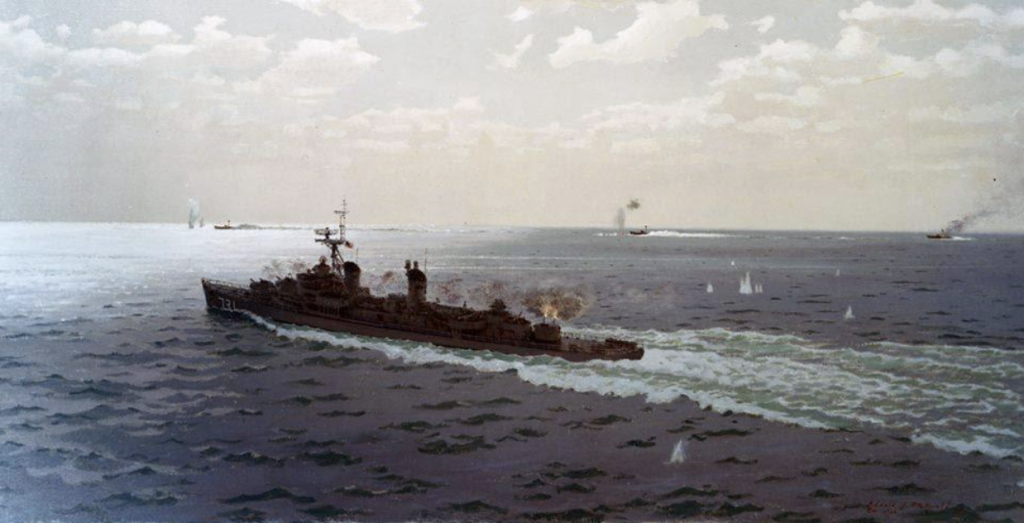
North Vietnam’s leaders, aware of the American connection and the apparent involvement in Operation 34A, were unbending. Hanoi ordered its small navy to retaliate against the American destroyer, which, from the Northerners’ perspective, appeared to be directly supporting the attacking PTFs. On the afternoon of August 2, the Communists sent three Soviet-built P-4 motor torpedo boats against Maddox. The launched torpedoes missed their target, and enemy deck guns struck the destroyer’s superstructure with little effect. The North Vietnamese naval vessels were less fortunate. Shellfire from Maddox hit the attackers. Then F-8 Crusader jets from USS Ticonderoga (CVA 14) strafed all three P-4s, leaving at least one boat dead in the water and on fire. The President and his national security advisors were surprised that Ho Chi Minh had not only resisted U.S. military pressure but had also responded so aggressively. Johnson and the appropriate military commanders decided that the United States could not simply disregard this unsuccessful counterattack. Maddox was then reinforced with the much more capable destroyer USS Turner Joy (DD 951) and ordered to continue an intelligence-gathering mission off North Vietnam. Two days later, on the night of August 4, the warships reported again making contact and then being attacked by several fast craft. Subsequent analysis of that data and additional information gathered on the August 4 episode make clear that North Vietnamese naval forces did not attack Maddox and Turner Joy that night. No matter.
Artist’s conception of the USS Maddox fighting off the 3 North Vietnamese PT boats
In response to the actual attack of August 2, the suspected debunked second attack on August 4, and even more questionable intelligence, the President nevertheless ordered the Seventh Fleet’s carrier forces to launch large-scale retaliatory strikes against North Vietnam. On August 5, aircraft from the carriers Ticonderoga and Constellation destroyed an oil storage facility at Vinh and either damaged or sank about 30 enemy naval vessels in port or along the coast. More significantly, on August 7, in early 1965, after re-election and a campaign promise to seek peace, the President ordered the deployment of major U.S. ground, air, and naval forces to South Vietnam. This marked the beginning of the costly war in Vietnam. The American leadership’s blood was up, so to speak; no little pip-squeak country was going to challenge the U.S. and get away with it. Most significantly, on August 7, the U.S. Congress overwhelmingly passed the so-called Tonkin Gulf Resolution; the complicity of the South’s classified PTF attacks was not publicly revealed. This congressional action cleared the way for Johnson to use military force as he saw fit, anywhere and everywhere against the Vietnamese Communists. In so many words, he could do whatever he felt necessary; the War Powers Authority of Congress had been completely delegated to the Commander-in-Chief, i.e., the President. Congressional oversight authority in this case was totally neutered.
We had already begun a ‘gradual escalation’ to avoid appearing too aggressive by sending advisors and equipment. President Johnson wanted to look like a peace candidate during that year while remaining strongly anti-Communist so that he could be reelected, defeating an opponent who openly favored the use of nuclear weapons. Then, after his re-election not wanting to look soft in the eyes of the international community and out of a deteriorating, politically corrupt country, we and several of our anti-communist allies flooded it with major army and marine units on the ground, the navy bombarding the enemy’s coastline, and air force and navy planes bombing this fourth-rate country until they surrendered or came to the negotiating table; in reality, there wasn’t much to blow up in this largely agrarian country to begin with. So, it ought to be easy. The northerners would later reveal that bombing only made them resist more, and as long as bombing went on, any thought of negotiations was impossible. In their case, they were willing to pay any price for as long as it took for the liberation of the South, and they meant it. During WWII, Germany and Japan also held comparable views and held out until they were totally conquered by nuclear weapons and soldiers on the ground; total defeat. Moreover, in the south, we utilized more or less the wholesale application of firepower, which wreaked havoc all over the south, irrevocably causing massive carnage to the very people we were ostensibly trying to help.
“Never get involved in a land war in Asia”
From the movie, The Princess Bride
Even though that quote comes from a movie, it captures, in the simplest terms, the strategic and tactical problems in a military action like this. Napoleon, MacArthur, the Japanese, and the Germans (twice) learned this the hard way. Even an elementary understanding of history and the classic rules of war, whether by military strategist Clausewitz or by Sun Tzu, clearly identified major flaws in American actions and the resulting misuse of our military, but these insights were apparently disregarded; our ‘best and brightest’ leaders were just too smart. What was our strategy? For example, Clausewitz, in ‘On War,’ would, in so many words, advise looking for the “center of gravity,” where the enemy is most vulnerable. Sun Tzu held that the best way to win a war is without fighting, among so many other tidbits. Another strategy holds that amateurs study tactics, while professionals study logistics, but in Vietnam all of these thought processes, like so many aspects of this evolving war, were somehow discounted to one degree or another; we had forced ourselves to behave like short-term-thinking amateurs, focusing on attrition, bombing, massive use of firepower, indiscriminate killing in both the north and south, wearing down the enemy, while in fact wearing ourselves down at the same time. Internal fatigue and popular opinion eventually undermined our own efforts.
For example, attacking the enemy’s logistics pipelines had worked with enormous success during WWII through the ‘Transportation and Oil Plans,’ which were designed to strangle the enemy by cutting off supplies and the movement of Nazi forces, or by severing oil supplies in South Asia from the Japanese fleet. Yet, as with so many aspects of this new conflict, this approach was apparently disregarded or overruled by the Johnson administration’s brain trust. It is generally recognized that Wellington, Napoleon, and Alexander the Great owed much of their success in the field to their understanding and attention to logistics. Briefings by the Joint Chiefs to the President prior to the build-up in 1965 proposed a strategic blockade of the north, including mining, attacks on all rail and road systems, and discussed the potential use of tactical nuclear weapons as alternatives to the less desirable introduction of massive ground forces. The Joint Chiefs of Staff were, however, largely marginalized. The civilian ‘best and brightest’ knew better and took over not only what they considered strategy but also the tactical employment of forces.
Many believe our Constitution is increasingly being replaced by an unelected, unaccountable administrative state that can govern without the consent of the people or Congress. This points to a rise in bureaucratic authoritarianism that sidesteps constitutional principles, replacing the rule of law with regulations and executive orders. While the Constitution mandates Congressional approval for military actions, nuclear weapons made an immediate response necessary.
As President Madison warned, the trust and temptation would be too great for any one man, which is why Congress was given sole authority to declare war under Article I. This rule has been repeatedly violated by Presidents from both parties. Best precedent? The North never officially declared war on the Confederacy during the Civil War, our deadliest conflict; it was orchestrated through presidential decrees. Over time, more precedents and reinterpretations have expanded presidential powers, especially since the advent of nuclear weapons, which are under the President’s exclusive control, enabling him to launch pre-emptive strikes at any target without oversight.
Looking back at the events of ‘64 and ‘65, there was an accumulation of questionable decisions, coincidental events that appeared to have been orchestrated, actions based on knowingly dubious intelligence, and nondisclosure of the Desoto Patrol, all of which distorted the actual sequence of events. The Vietnamese thought we were attacking them, while we were told they were attacking us. Worst of all, there seemed to be a disregard for sound military practices. It’s still hard to understand how all this could have happened, but it did. The paranoia about Communism must have been overwhelming. We didn’t recognize that we were dealing with Communist fanatics who cared nothing for the presence of colonial powers and would pay any price to defeat them.
The world expects America to lead diplomatically and in measured ways rather than declaring war, bombing selectively, and sending or threatening to send ground forces at the president’s pleasure. From the lessons we learned from Vietnam, Iraq, Iran, and Afghanistan, what have we learned? Some parts of this scenario seem to be repeating themselves even as I write this essay.
THE PAST IS PROLOGUE
This quotation is engraved on the National Archives Building in Washington, D.C.