The U.P. Falling Further and Further Behind?: An Comparison of Median Household Income Growth
Earlier this year Rural Insights published an article, “Voters Being Misled About the Cause of Michigan’s Economic Decline.” It was based on a poll of the state’s registered voters and found that most are “in the dark” about its sharp decline. According to the results, voters think Michigan “fares about average compared to other states in education, reading, income and jobs.” The reality is far worse: Michigan “is near the bottom in almost every one of those categories.” Moreover, over the past 50 years, Michigan trails every state, except West Virginia, in median household income growth. Michigan’s median household income ranked 7th in the nation in 1970, by 2023 it was 38th. The state’s slow growth is in contrast to other Great Lakes States. As late as 1989, Michigan’s median household income was the highest among its four regional counterparts (Table 1), by 2024 it was the lowest.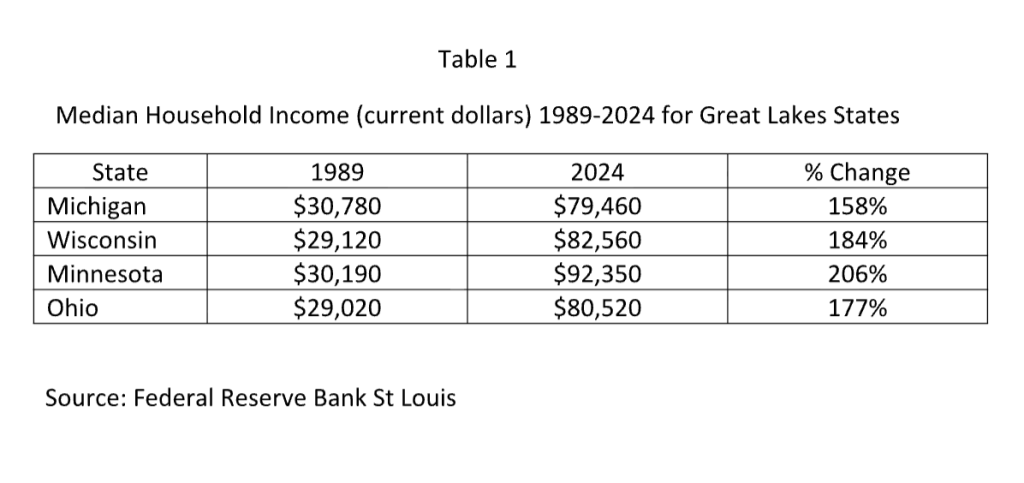
Much of Michigan’s slow growth is attributable to the declining fortunes of the state’s manufacturing sector, as over 300,000 factory related jobs have disappeared in the past 25 years. Given the focus on deindustrialization in the state’s major metropolitan areas, how have the state’s rural counties fared in terms of income growth? This article aims to address this issue by comparing income and population growth in the U.P.’s 15 counties with seven rural counties in Wisconsin that are adjacent to the U.P. or along the shore of Lake Superior.
Factors Associated with Growth in State Median Household Income
According to the Urban Institute’s report Is Your State Better Off Now Than It Was 50 Years Ago? the most important factor linking change in income is a state’s educational attainment. Between 1970 and 2023 Massachusetts, Vermont, New Jersey, Colorado, Virginia, New Hampshire and Maryland had the largest increase in residents with a bachelor’s degree. These states were respectively ranked 1st, 17th, 2nd, 9th, 11th, 4th, and 3rd on median household income in 2023. Contrary to popular wisdom, a warm sunny climate and low taxes (i.e. the Sunbelt), provides mixed support for income gains, with Texas and Arizona experiencing significant gains, while Nevada and New Mexico’s gains were much lower. Indeed, the study found that lower-temperature states and higher-property-tax states tended to fare better on change in median household income. This suggests, according to the study’s authors, that greater tax revenues enable investments in education and workforce development to help drive income growth. The study concludes that for states aiming to improve their residents’ prosperity, policymakers should consider strategies promoting higher-wage sectors and growing their talent pool through education and workforce development.
How Does the U.P.’s Growth in Income Compare With its Wisconsin Counterparts?
U.S. Census estimates of median household income for 1989 and 2024 were obtained for each of the 22 counties in the study (15 in the U.P., and 7 in Wisconsin), and ranked for each time period (Table 2). Most U.P. counties experienced smaller gains in household income compared with rural Wisconsin counties. Only Keweenaw, and Mackinac improved their ranks. Keweenaw’s change can be attributable to an influx of college graduates and their associated higher incomes. The Census Bureau estimates that the county now has the highest percentage of persons with a Bachelor’s Degree or higher (41.2%) of any U.P. county, including Houghton and Marquette counties, which are home to two Universities.
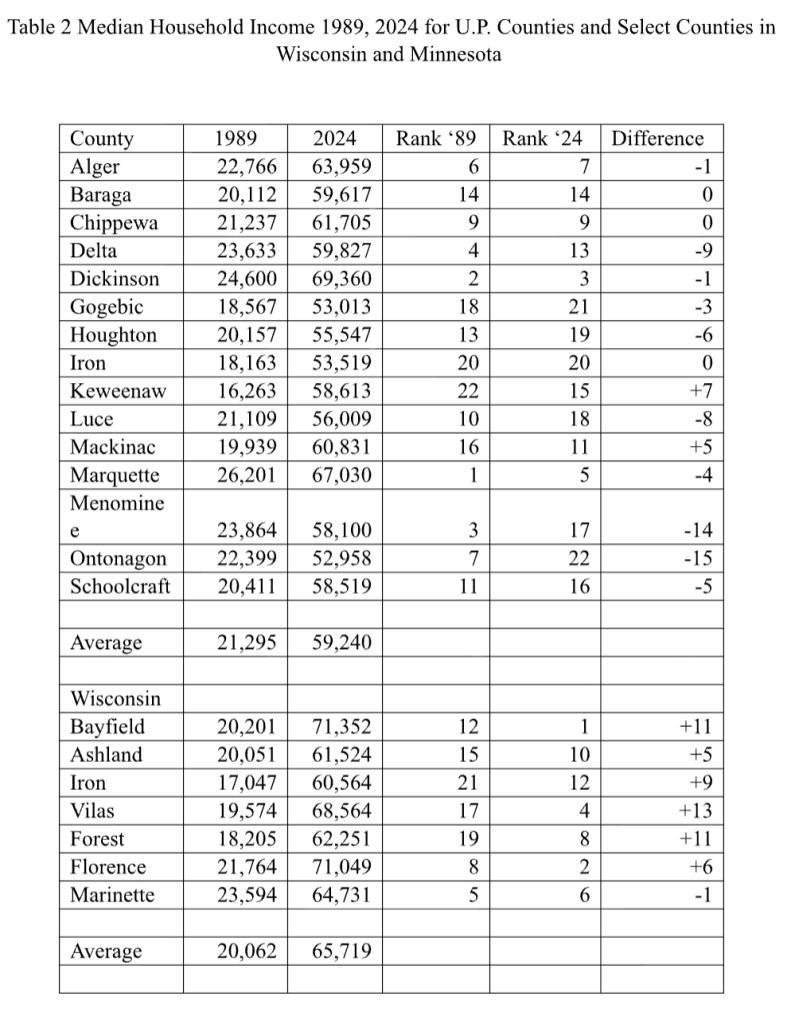
The majority of U.P. counties dropped their rankings between 1989 and 2024, meaning Wisconsin’s counties outpaced their U.P. counterparts in median household income growth. Marquette County’s experience is particularly notable. In 1989, it was ranked first in median household income, by 2024 it dropped to 5th. Part of the reason for its relative decline was the closure of K I Sawyer Airforce base in the mid-1990s; at its peak the base was the U.P.’s largest single employer. Twenty years after the closure, the Empire mine closed with the loss of over 400 high paying jobs, a few years later the Presque Isle Power Plant closed with a further loss of well-paying jobs. Menominee and Ontonagon Counties experienced even larger drops in their rankings, due to the loss of jobs in the manufacturing and mining sectors. When the White Pine mine closed in Ontonagon in the 1990s, the county lost over 1,000 jobs and 40 percent of its economic activity, while the number of manufacturing employees in Menominee dropped by a third between 1989 and 2024. Delta county’s drop in the rankings is also associated with a similar drop in manufacturing employment.
In contrast to the U.P., Wisconsin’s counties have enjoyed steadier economic growth and an improvement in rankings. Bayfield and Vilas counties, for example, experienced a significant boost in their rankings (and income) as a result of a shift away from forestry and other traditional industries to a service-based economy. This transition has been aided by a steady increase in population dating back to the 1970s. This growth is driven by an influx of migrants. Between 1989 and 2024 the population for the 7 Wisconsin counties went from 107,830 to 119,521 a 11 percent gain; during the same period the U.P.’s population declined from 312,832 to 304,004 a drop of 3 percent.
Conclusions
Part of the U.P.’s slower growth in median household income is attributable to the loss of manufacturing and mining jobs. In contrast to the U.P.’s historic dependence upon mining and manufacturing rural Wisconsin counties have benefited from an increase in population, a growing service sector and larger gains in household income. For the past several years the state legislature has debated providing $50 million for the Highland Copperwood project in the western U.P. The mine will provide a short-term economic boom to the region, and when the mine is closed at the end of its 11-year life span, the jobs will disappear. Déjà vu all over again. As voters consider their choices for the upcoming fall elections, they might wish to consider what policies candidates propose to stem the state’s economic slide, (if that is what they want). It’s clear that previous policies enacted by the state legislature have been largely ineffective in addressing the state’s declining economic fortunes. Most wealthier states have made the transition to a technology rich, knowledge economy and invested in increasing their so-called human capital. Is it time for Michigan to make a similar investment?